
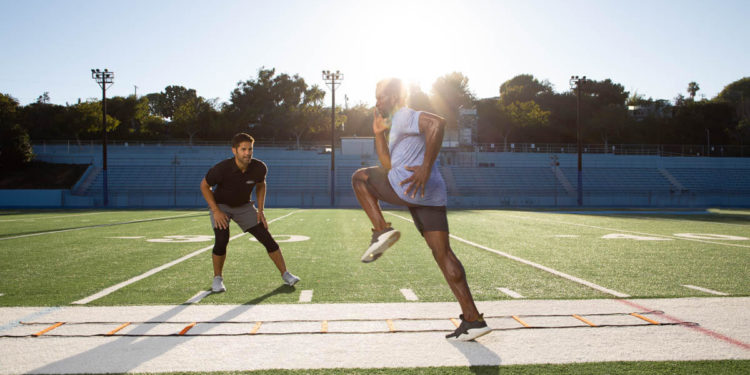
In general, we have two high points and two low points in the day when fatigue is at its highest or lowest. These high points and low points coincide with peak and troughs in core body temperature, respectively. Mental acuity is required to execute highly coordinated movements with a higher risk of injury, so it’s understandable why this relationship with time of day matters for the top-performing athlete.
To date, there are some data trends from the regular season of the National Football League showing that risk for injury is highest when mental fatigue due to drops in core body temperature is highest compared to any other time of the day.
These data trends also reveal that west coast teams tend to have better regular-season winning percentages due to playing fewer games in their biological afternoon and more evening games when we experience a “second wind” in alertness/motivation.
If we want to be hyper-analytical, then we can also consider how being a morning person or evening person affects the dynamics, performance, and winning percentages of a group.
Data on this topic has been collected in field sport athletes (rugby, field hockey, and soccer) at both elite and amateur levels.
The consensus is a healthy dose of variability in peak morning players versus peak evening players is okay for as long as it doesn’t exceed 25%. Thus, either have a group class or team where 75% self identify as morning larks or night owls for maximal success.
CONCLUSION
To conclude, the concept of training around the clock is a concept of training smarter, not harder.
By prioritizing workouts and recovery around your pre-programmed biological needs, the entire human physiological system is less stressed in general. Your biological clocks will not have to keep adjusting and re-adjusting to sleeping at a non-optimal time, training at a non-optimal time, and eating at a non-optimal time. Your biological clocks will also thank you if you keep a consistent routine.
Consistency helps keep the biological clocks in sync, so the act of releasing hormones, repairing muscle, and recruiting energy stores is expected, prioritized, and executed to the fullest human potential.
REFERENCES
A. J. Brager, R. M. Mistovich, Game times and higher winning percentages of west coast teams of the National Football League correspond with reduced prevalence of regular season injury. J. Strength Cond. Res. 31, 462-467 (2017).
E. Facer-Childs, R. Brandstaetter, The impact of circadian phenotype and time since awakening on diurnal performance in athletes. Curr. Biol. 25, 518-522 (2015).
R. Mora-Rodríguez, J. García Pallarés, Á. López-Samanes, J. F. Ortega, V. E. Fernández-Elías, Caffeine ingestion reverses the circadian rhythm effects on neuromuscular performance in highly resistance-trained men. PLoS ONE. 7, e33807 (2012).


